AI trading is reshaping the world of finance, enabling traders to make informed decisions based on complex data analysis. This innovative approach combines artificial intelligence and trading strategies, creating a powerful tool for both novice and experienced traders. As we explore the concepts behind AI trading, it becomes clear how much this technology is influencing our approach to the markets.
What Is AI Trading?
AI trading refers to the use of artificial intelligence technologies to execute trades in financial markets. This involves sophisticated algorithms that analyze vast amounts of data, identifying patterns and trends that may not be visible to the naked eye. Through automation, AI trading systems can make real-time trading decisions without human intervention.
These systems rely on models that learn from historical data. They continuously adapt and improve their strategies, increasing the accuracy of predictions. The main goal here is to enhance the efficiency of trading operations while minimizing risks. Traders can access AI trading tools through platforms that offer various levels of automation and customization.
A key feature of AI trading is its ability to process information much faster than humans. This speed enables traders to react immediately to market changes, capturing opportunities as they arise. Moreover, AI trading leverages advanced statistical techniques to predict market movements, taking into account numerous variables simultaneously.
How AI is Transforming Trading Strategies
AI is revolutionizing trading strategies in significant ways. One major change is the shift from traditional methods to data-driven approaches. Previously, traders relied heavily on gut feelings and instinct. Now, they have access to advanced tools that provide insights based on accurate data analysis. This shift enhances the overall quality of trading decisions.
With AI, the prediction accuracy of market trends has improved dramatically. Machine learning algorithms analyze everything from historical price movements to news headlines, creating sophisticated models that help traders anticipate price changes. These data-driven predictions can give traders a competitive edge in interpreting market signals.
Moreover, AI can optimize trading strategies by backtesting them against historical data. This process allows traders to evaluate how different strategies would have performed in various market conditions. By refining their approaches, traders can maximize profits while reducing potential losses.
AI is also fostering the integration of multiple trading strategies. For instance, combining statistical arbitrage with sentiment analysis and technical indicators can create a robust trading system. This multifaceted approach allows traders to capitalize on different market scenarios, enhancing their trading repertoire.
As AI technologies continue to evolve, we can expect even richer insights into market dynamics. The sophistication and adaptability of AI systems will lead to the creation of even more innovative trading strategies. Embracing these advancements can open doors to exciting opportunities within the financial markets.
Key Components of AI Trading Systems
When we talk about AI trading systems, a few key components come into play. These elements make up the backbone of how these systems operate and succeed in the fast-paced world of trading. Let’s dive into them one by one.
Data Acquisition
The first vital component is data acquisition. For any AI system, data is the fuel. In trading, the right data can include historical price movements, trading volume, market news, and even social media sentiments. Every little piece matters. It’s not just about having data; it’s about having the right data. The more comprehensive and high-quality the data is, the better the AI can perform its analysis and predictions.
Data Processing and Cleaning
Once data is acquired, it’s time for processing. Raw data often comes in a messy state. Cleaning involves removing inaccuracies and inconsistencies, making it usable for the next steps. This process also includes normalizing data, which helps in ensuring that AI can understand and process it effectively.
Machine Learning Algorithms
Now we reach the heart of AI trading: the machine learning algorithms. These are the mathematical models that allow the system to learn from the data. Different algorithms can be implemented based on the trading strategy. Decision trees, neural networks, and support vector machines are just a few examples. Each approach has its strengths and weaknesses, and the choice depends on the specific trading goals.
Trading Signals Generation
After processing the data and applying machine learning, it’s time to generate trading signals. These signals indicate when to buy or sell an asset. An effective AI trading system generates accurate signals that can lead to profitable trades. The accuracy here relies heavily on the quality of data, choice of algorithms, and the overall model’s training.
Backtesting
Backtesting is a crucial step in AI trading systems. It involves testing the trading model using historical data to see how it would have performed in the past. If a system can generate profits in backtesting, it increases the confidence in its ability to perform in real-time trading.
Risk Management Tools
No trading system is complete without risk management tools. AI trading systems employ various strategies to minimize risk. This might include setting stop-loss orders or adjusting position sizes based on volatility and market conditions. The goal is to protect capital while maximizing potential gains.
Execution Mechanism
Finally, there’s the execution mechanism. After generating trading signals and implementing risk management, an execution system is needed to carry out trades efficiently. In fast-moving markets, the speed of execution can significantly impact profitability. Systems must be able to execute orders promptly and accurately.
Putting all these components together helps create a robust AI trading system. They work in harmony to analyze data, generate signals, manage risks, and execute trades, ultimately aiming for success in the dynamic trading landscape.
AI Trading Bots: Automation at Its Best
AI trading bots are becoming an essential part of modern trading. They automate trading processes, saving time and reducing emotional influences that can cloud judgment. Imagine having a system in place that works round the clock, analyzing market conditions and executing trades without the need for constant supervision. That’s the power of AI trading bots.
These bots utilize complex algorithms to serve various functions in trading. They analyze vast amounts of data, identifying patterns and signals that human traders might miss. This capability to process and interpret large datasets gives them an edge in the fast-paced trading environment.
The efficiency of AI trading bots is one of their most appealing features. They can operate 24/7, constantly monitoring the market for trading opportunities. This level of availability means that opportunities won’t be missed due to human frailty like sleep or distraction. Additionally, these bots execute trades at lightning speed, reacting to market changes much faster than a human ever could.
Another factor contributing to their effectiveness is their emotion-free decision-making. Traders often experience fear or greed, leading to poor choices. AI trading bots, on the other hand, follow pre-set rules and strategies without the influence of emotions. This disciplined approach can lead to more consistent performance over time.
However, like any technology, AI trading bots come with their own set of challenges. It’s crucial to ensure that the underlying algorithms are sound and that they have enough data to make informed decisions. Moreover, users must remain aware of the limitations of the bots. They may perform exceptionally well in specific market conditions but could struggle during market volatility.
In conclusion, AI trading bots represent a leap forward in trading automation. They offer impressive efficiency, speed, and reduced emotional interference. As trading technology continues to evolve, these bots will become increasingly important in making trading decisions and optimizing strategies. The future of trading is undoubtedly intertwined with the capabilities of AI trading bots.
Machine Learning Techniques in Trading
Machine learning has become a cornerstone in the field of trading. It enables traders to analyze vast amounts of data efficiently. Let’s break down some techniques used in trading.
Supervised Learning
Supervised learning involves training a model on labeled data. It means we have historical data and the corresponding outcomes. For example, we might feed a model with past stock prices and whether they went up or down. The goal is for the model to learn from this data, identifying patterns and making predictions. Traders can use these predictions to decide when to buy or sell.
Unsupervised Learning
Unsupervised learning, on the other hand, works with unlabeled data. The algorithm tries to find hidden structures without any prior examples. In trading, this can be useful for identifying trends or clusters in data. For example, it could group similar stocks based on their price movements. This approach helps traders discover new opportunities they might not have considered.
Reinforcement Learning
Reinforcement learning is about training a model through trial and error. The system learns by taking actions and receiving feedback. For instance, if a trading bot makes a good trade, it gets a reward. If it makes a bad trade, it receives a penalty. Over time, the model becomes better at making decisions, improving its trading strategies. It’s like teaching a dog new tricks, but instead, we’re teaching an algorithm how to trade more effectively.
Conclusion
These techniques show how flexible and powerful machine learning can be in trading. They allow for more accurate predictions, better understanding of market behavior, and adaptive strategies. As technology evolves, we can expect even more sophisticated methods to emerge, enhancing the way we trade in various markets.
Advantages of AI in Forex Trading
AI is changing the game in Forex trading. It brings speed and precision that humans just can’t match. Think about it. With AI, we can process vast amounts of data in seconds. Traditional traders might spend hours analyzing charts. An AI can do this in moments, highlighting trends and patterns that we might overlook.
Data processing is one of the biggest advantages. AI systems can analyze market signals from multiple sources simultaneously. They take into account economic indicators, news releases, and even social media sentiment. This multidimensional analysis leads to more informed trading decisions. The accuracy of predictions can significantly increase because AI uses historical data to spot relevant patterns.
Risk management is another area where AI shines. AI algorithms can assess market volatility and automatically adjust trading parameters. For instance, if volatility spikes, an AI can tighten stop-loss orders. This helps in protecting investments. Human traders may panic or hesitate during tricky market conditions. AI remains calm, making calculated decisions without emotional bias.
A major advantage is the continuous operation. AI trading systems can run 24/7 without fatigue. They don’t need breaks or sleep. This means they can capture opportunities in any market condition, even while we rest. For Forex traders, this means potential profits at any hour.
Moreover, AI can learn from every trade. Machine learning algorithms improve over time. They adapt to changing market conditions, becoming more effective with every transaction. This adaptability keeps traders ahead in the competitive Forex market.
Lastly, AI reduces the barriers to entry. Even novice traders can benefit from AI trading tools. They provide insights and automate complex strategies, making Forex trading more accessible. It allows anyone to participate in the market with a level of professionalism that was previously out of reach for most.
In summary, the advantages of AI in Forex trading are clear. From enhanced data processing to effective risk management, AI is transforming how we trade. Its ability to operate nonstop and adapt to market changes offers significant benefits that can elevate any trading strategy.
Challenges and Limitations of AI Trading
AI trading is impressive, but it comes with its own set of challenges and limitations that we must consider. One major issue is data quality. For AI to make accurate predictions, it needs clean, reliable data. However, in the financial markets, data can be noisy, inconsistent, or incomplete. If the training data has errors, the model’s performance can suffer greatly.
Another challenge is privacy. With AI systems relying on vast amounts of data, including personal information and trading behaviors, concerns about data security arise. Traders want to know that their data is protected and not being misused. Regulations around data privacy can complicate how AI systems operate, adding another layer of challenge.
Overfitting is yet another limitation. This occurs when a model becomes too complex and starts to capture noise rather than the underlying patterns in the data. An overfitted model may perform well on historical data but poorly on new data. Striking the right balance is crucial for the effectiveness of AI trading systems.
Transparency in AI decision-making is also a hot topic. Many AI algorithms, especially those based on deep learning, operate as black boxes. Traders and analysts often struggle to understand how decisions are made. This lack of transparency can lead to mistrust. Investors need to know the rationale behind trades, especially in volatile markets.
Finally, the fast pace of financial markets adds another layer of complexity. AI systems need to adapt to changing market conditions, and this can be difficult. Models trained on historical data may not always account for sudden market shifts, leading to unexpected results. Keeping AI systems updated and relevant is an ongoing challenge that requires constant attention.
Case Studies of Successful AI Trading Implementations
Let me share some fascinating examples of how AI has transformed trading approaches for various firms. These case studies not only highlight innovation but also the tangible benefits of incorporating AI into trading systems.
“AI trading has opened avenues for precision and efficiency that were previously unimaginable.”
Example 1: Renaissance Technologies
Renaissance Technologies, a quantitative hedge fund, is a great example to look at. They use complex mathematical models and machine learning algorithms to analyze huge data sets. Their Medallion Fund achieved remarkable success by leveraging AI. These models can identify patterns that humans might overlook. Imagine algorithms predicting market movements with astonishing accuracy. Their returns have often outperformed traditional funds, showcasing AI’s potential in this space.
Example 2: Goldman Sachs
Goldman Sachs integrated AI into their trading operations through a system called Marquee. This platform provides clients with data analysis and trading tools driven by machine learning. They have seen increases in efficiency and decision-making speed. The AI can process information faster than any trader could, which means better responses to market changes. It allows Goldman Sachs to remain competitive in a rapidly evolving landscape.
Example 3: BlackRock
BlackRock, one of the largest asset management firms, utilizes AI for risk management. Their Aladdin platform incorporates AI to predict bond prices, enhancing their ability to manage portfolios effectively. They analyze vast amounts of market data in real-time, which leads to smarter investment decisions. This approach minimizes risks and optimizes returns for their clients.
Example 4: Trade Ideas
Trade Ideas developed an AI called Holly that scans the markets for potential trading opportunities. Holly uses a mix of strategies derived from historical data. It’s remarkable how it can simulate thousands of scenarios daily. Traders get access to insights that were previously unavailable, elevating their trading strategies. Holly has helped many traders achieve significant gains and refine their tactics.
Example 5: Zorro AI Trading Platform
Zorro has also made waves in the AI trading community. This platform allows individual traders to implement AI strategies without needing extensive coding knowledge. Users can automate their trading processes and develop algorithms based on their unique trading styles. This democratization of AI in trading is transforming how everyday traders approach the markets.
These case studies illustrate the diverse applications of AI in trading. From hedge funds to individual platforms, the impact of AI is clear. The trend is towards automation, enhanced decision-making, and ultimately, more informed trading strategies. The future looks bright for AI in trading, and these examples are just the tip of the iceberg.
Ethics and Regulation in AI Trading
AI trading is evolving quickly. As it becomes more integrated into financial markets, the conversation around ethics and regulation is gaining momentum. How do we ensure that these advanced systems operate fairly? What responsibilities do developers and traders hold?
One main concern is compliance. Regulations vary widely across different markets and jurisdictions. It’s essential for AI trading systems to adhere to financial laws. This ensures that traders using these systems are operating within legal frameworks. Non-compliance can result in fines, legal action, or even the shutdown of operations. Therefore, understanding the regulatory landscape is critical for anyone involved in AI trading.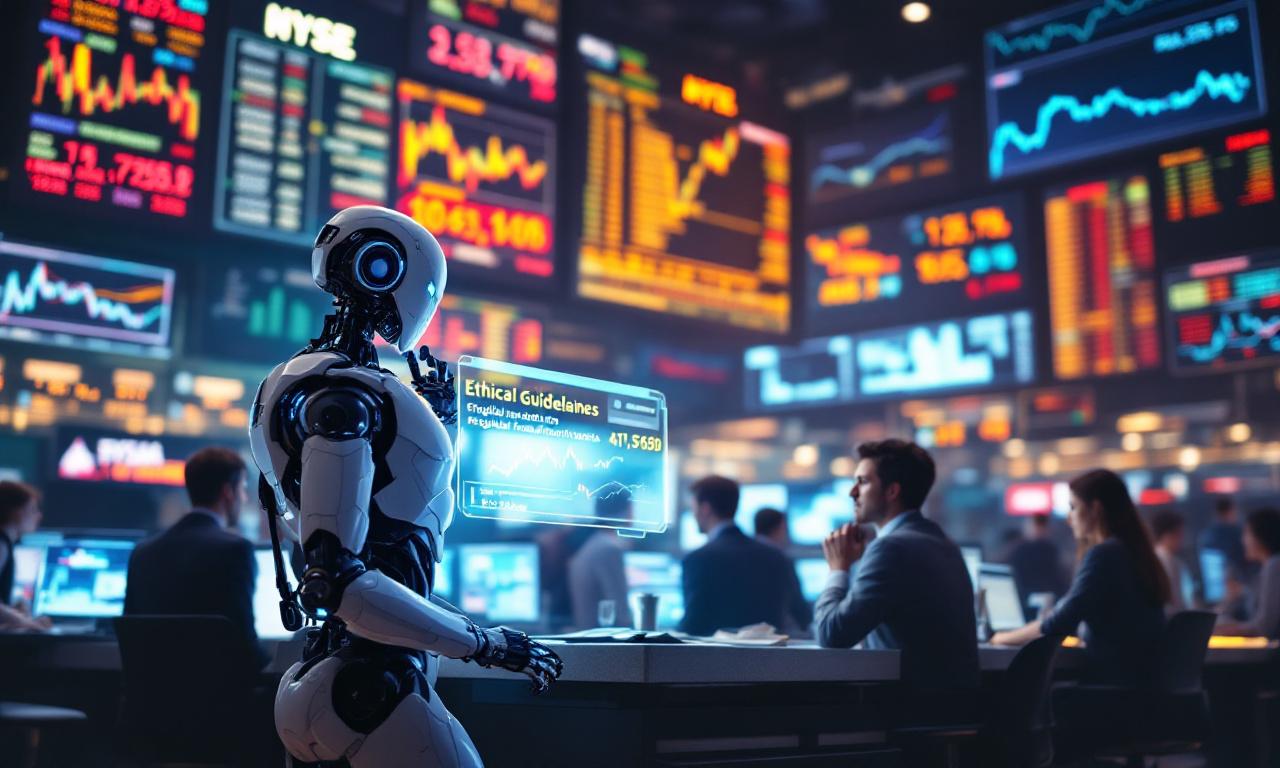
Another significant issue is market fairness. AI can create imbalances if misused. For instance, if an AI trading bot has access to exclusive data, it can gain an unfair advantage over other traders. This could lead to a situation where a few players dominate the market, leaving others behind. Keeping the market fair means that everyone should have access to the same data and tools. Ethics should guide the development of AI trading algorithms, ensuring they do not exploit loopholes or create unfair advantages.
Transparency is also crucial. Many AI trading models, especially those employing deep learning, can appear as black boxes. This obscurity is problematic. Traders need to trust that the algorithms are making decisions based on sound logic and not just random patterns. Clear documentation and explanation of how these trading models operate can help build trust among users.
Moreover, the impact of AI on jobs within the trading industry should not be overlooked. Automation can lead to job displacement for traditional traders. While AI can increase efficiency, it’s essential to consider how this technology will reshape the workforce. Retraining programs and resources will be necessary to help those affected by these changes. Ethical implementation of AI should include strategies for worker transition.
In conclusion, as we explore the capabilities of AI in trading, we must also confront these ethical dilemmas. Regulations should evolve alongside technology, creating a framework that promotes fairness and transparency. After all, the way we approach these issues today will define the future of AI trading and its role in global markets.
The Future of AI Trading
AI trading is evolving fast. Technology keeps advancing, and so do trading strategies. Imagine a world where algorithms predict market moves with pinpoint accuracy. That’s what we’re heading towards. New trends are emerging that make trading smarter, faster, and more efficient.
One major trend is the increased use of big data analytics. Traders now have access to massive amounts of data. The challenge is how to make sense of it all. AI algorithms sift through this data, identifying patterns that a human trader might miss. This leads to more informed decisions.
Another exciting development is the rise of deep learning. This involves training neural networks on historical trading data. These networks learn from past market behavior, improving their predictions over time. As technology advances, so does the ability to process complex data sets. The combination of machine learning and deep learning could change the game in trading.
There’s also the rise of decentralized finance (DeFi). AI trading can integrate with DeFi platforms to automate trading strategies. This helps traders take advantage of opportunities in real-time without manual intervention. It’s all about increasing speed and reducing human error.
The future isn’t just about technology improving. It’s about ethics too. As AI trading becomes more prominent, regulations are likely to tighten. Market fairness will be under scrutiny. Traders need to ensure their strategies comply with regulations to avoid penalties.
In summary, the future of AI trading looks bright. There will be more efficient systems, better predictions, and a greater focus on ethical trading practices. It’s an exciting time to be involved in trading. Embracing these changes can lead to great opportunities.